General Engineering & Electric Welding
( Swansea ) Ltd.
|
|
|
Roger
Phillips Jones’ father, George Phillips Jones, founded
General Engineering & Electric Welding (Swansea) Ltd.,
known to all as “Georgie Jones’s”, and Roger has kindly
provided the following information on his father’s
company, together with some interesting photographs.
|
|
My father, George Phillips Jones, served his time in
the Central Dry Dock, now part of Salisbury’s Car
park. In 1926 he started up General Engineering &
Electric Welding (Swansea) Ltd. in Burrows Place
alongside the Swansea Museum, and in 1935 he
relocated the company to the Cambrian Dry Dock.
|
|
Harris Brothers had been operating the Cambrian
Dry Dock but they became bankrupt in 1934 and
the dry dock was closed. In 1935 the plant and
machinery was sold, the premises were bought by
the Swansea Council, and my father became a
tenant on part of the site. The Council operated
it as a Public Dry Dock, although General
Engineering was by far and away the main user,
and the yard was known throughout the docks as
“Georgie Jones’s”. When I ceased using the dry
dock in 1966 the Council filled it in, and it is
now the slipway for the Swansea Yacht and Sub
Aqua Club.
|
|
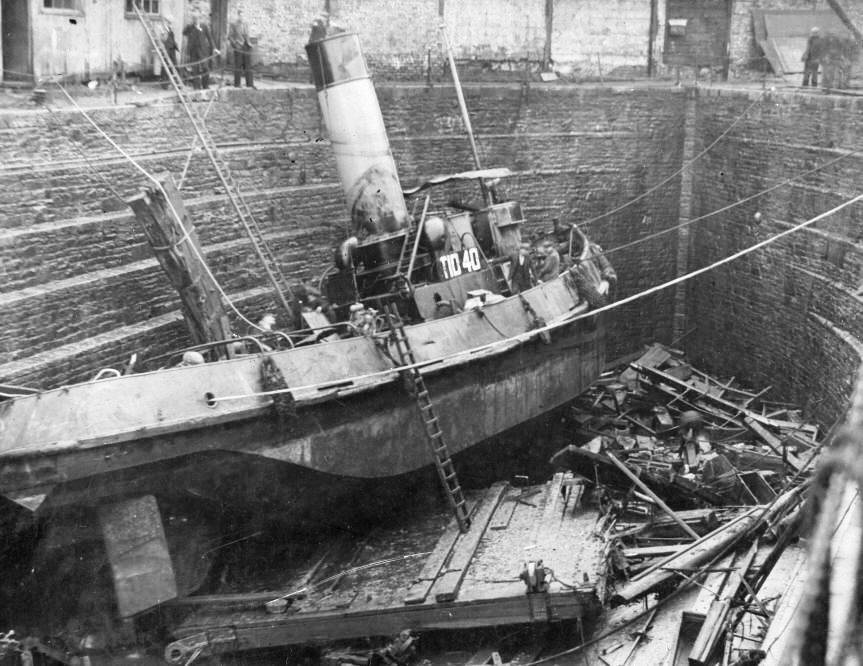
At 9.00 a.m. on Saturday 14th
April 1945 the dry dock’s lock gates
collapsed on a high tide and flooded the
surrounding streets. Two TID tugs - TID 40
and TID 41 - were in the dry dock at the
time and both were sunk, but fortunately
there were no casualties. In the photograph
of the incident, tidemarks can be seen on
the funnel of TID 40. The dry dock was out
of commission until 16th May
1946, during which time the Council fitted
new steel lock gates. The Trinity House
tender ‘Triton’ was the first ship to enter
the dry dock after this incident.
|
|
The original dry dock had been built at
90 degrees to the river, but in 1895 it
was enlarged and altered to 45 degrees
to the river - the new dimensions being
263 ft long and 41.6 ft wide. The
original wooden lock gates had been
enlarged by scarfing in additional
lengths of timber, and it was the rusted
fixing bolts on the scarf that gave way
that Saturday morning.
|
|
My
father died in 1961, shortly after I had left the sea.
Progressively through the 1960’s shipping was becoming
more and more difficult, and in 1964 the Swansea branch
of Campbell & Isherwood electrical contractors, to whom
we gave all our electrical work, decided to close their
Swansea branch. Campbells asked me to take on 5 of their
employees to do our own electrical work, which I did,
but I kept it separate from the dry dock to avoid the
difficult labour troubles that always seemed apparent on
the docks.
|
|

|
|
By 1966 the decline in shipping was such that it was
impossible to operate the dry dock so I had to close
the yard, and from that time on I only did
electrical work. Today my son Steven Phillips Jones
runs Phillips Services (Wales) Ltd and we employ
some 20 electricians from our premises in Manselton.
|
|
Our middle name comes from Captain George
Phillips (1784 to 1860) a well known Oyster Skiff
owner, quarry owner, and owner of the Ship and
Castle public house - all at Mumbles. |
|
Roger Phillips Jones |
|
(Note – the Cambrian Dry Dock referred to in this
article has also been known as Harris Dry Dock No.2,
Commercial Dry Dock No.1 and the Corporation Dry Dock)
|
|
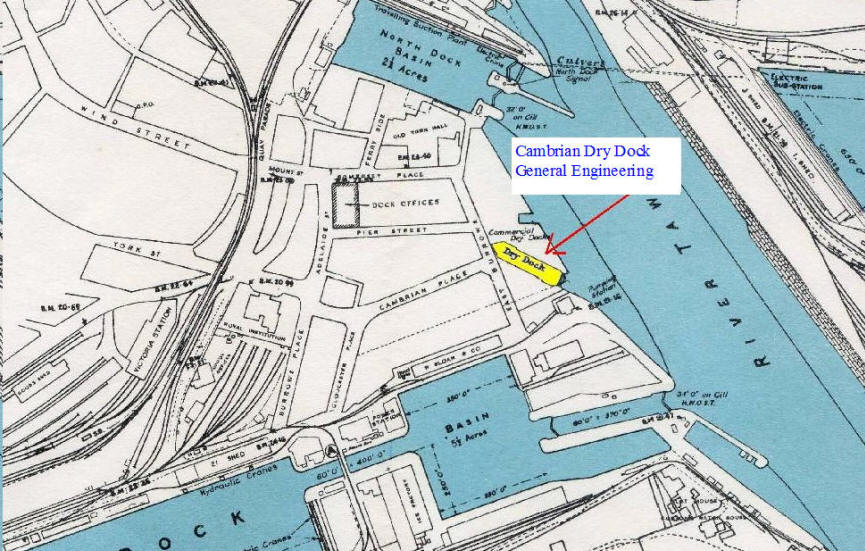
Map
showing the position of the Cambrian Dry Dock.
|
|
 |
|
|
Collapse of the Cambrian Dry Dock Gates
in 1945.
TID 40,
one of two tugs in the Cambrian Dry Dock when the lock gates
collapsed during a high tide on the 14th April 1945
|
|
 |
| |
|